Advertisements
Top weekly article
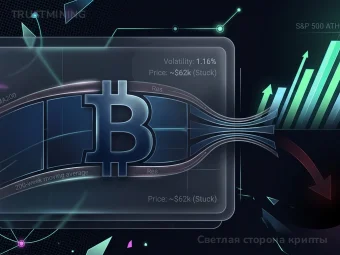

Светлая сторона крипты
Ветры зимы в криптосфере
Почему биткоин застрял на месте, пока фондовый рынок бьет рекорды




Share is a computational result produced by a miner that meets the difficulty configured by the pool and is submitted to the server for verification. Shares provide a measurable way for a mining pool to track the work performed by each participant.
During mining, hardware performs a very large number of hash operations. Most results have no significance for the blockchain network. If a pool required miners to submit only results meeting the full network difficulty, a small miner could go for a very long time without submitting anything. The pool would therefore have no practical way to continuously measure whether the device was working and how much work it was performing.
How a Share Is Created
- The pool creates or receives a current mining job.
- The job is sent to the miner through the communication protocol.
- The miner performs computations.
- A result meets the configured share difficulty.
- The miner submits the result to the pool.
- The pool verifies and either accepts or rejects it.
Share vs. Block
A share should not be confused with a block. They operate at different difficulty levels.
| Property | Share | Block |
|---|---|---|
| Difficulty | Configured by the pool for work accounting | Defined by the network |
| Frequency | Designed to be frequent enough for statistical tracking | Much lower |
| Economic role | Used to calculate the participant’s contribution | Creates eligibility for the block reward |
Occasionally, a share also satisfies the network-level requirement. In that case, it can represent a block discovery. Most shares, however, serve only as evidence of completed work for the pool’s internal accounting.
Types of Shares
Depending on the result and the time at which it is submitted, a share can be accepted, rejected, or considered stale. Pool monitoring therefore commonly distinguishes Valid Share, Invalid Share, and Stale Share.
Popular models

Brands


Fluminer

ElphaPex

Ebang

Canaan

Todek

Bitdeer

iPollo

Baikal

StrongU

VolcMiner

MicroBT

Lucky Miner

Jasminer

Auradine

Innosilicon

IceRiver

Hummer Miner

Holic

Heatbit

Goldshell

FusionSilicon

Bitaxe

Bitfily

Digital Shovel

Dayun

Bolon Miner

Braiins

BW

Halong Mining

Bitfury

Spondoolies

PinIdea

Pantech

Obelisk

DragonBall Miner

FFMiner

ForestMiner

GMO miner