Advertisements
Top weekly article
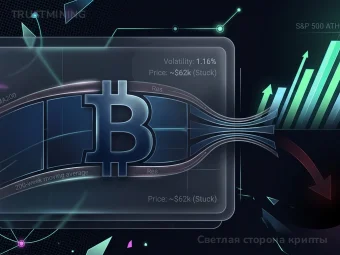

Светлая сторона крипты
Ветры зимы в криптосфере
Почему биткоин застрял на месте, пока фондовый рынок бьет рекорды




Hydro cooling is a heat-removal technology based on the circulation of liquid coolant through an engineered cooling system. In mining, the term commonly refers to systems that remove heat from high-load equipment through liquid circulation rather than relying primarily on large volumes of moving air.
The core of the system is a cooling loop through which coolant moves. The coolant receives heat from the equipment, travels to a heat exchanger, releases the thermal energy, and returns to the equipment.
Main Components
- cooling blocks;
- pumps;
- piping;
- coolant;
- heat exchangers;
- temperature, pressure, and flow sensors;
- control and protection systems.
Cooling Capacity
The system must have sufficient cooling capacity to match the equipment thermal load. If the system cannot continuously remove the heat generated by the miners, coolant and component temperatures will increase.
Delta T between coolant inlet and outlet is another important operating parameter. Combined with flow rate, it helps characterize how much heat the coolant is receiving from the equipment.
Mining Applications
Hydro cooling can be useful in high-density mining installations where moving large amounts of air would require substantial infrastructure and auxiliary power.
However, liquid infrastructure is more complex than basic air cooling. The system requires leak protection, pump maintenance, coolant monitoring, heat exchanger maintenance, and continuous control of operating parameters.
Popular models

Brands


Fluminer

ElphaPex

Ebang

Canaan

Todek

Bitdeer

iPollo

Baikal

StrongU

VolcMiner

MicroBT

Lucky Miner

Jasminer

Auradine

Innosilicon

IceRiver

Hummer Miner

Holic

Heatbit

Goldshell

FusionSilicon

Bitaxe

Bitfily

Digital Shovel

Dayun

Bolon Miner

Braiins

BW

Halong Mining

Bitfury

Spondoolies

PinIdea

Pantech

Obelisk

DragonBall Miner

FFMiner

ForestMiner

GMO miner