Advertisements
Top weekly article
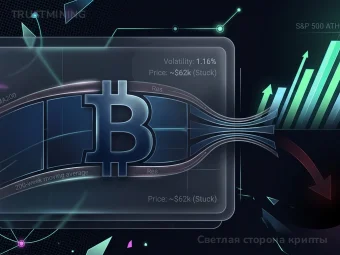

Светлая сторона крипты
Ветры зимы в криптосфере
Почему биткоин застрял на месте, пока фондовый рынок бьет рекорды



A Zero-Knowledge Proof (ZKP) is a cryptographic method that allows one party to prove to another that a statement is true without revealing the secret or underlying information on which the statement is based.
At a high level, a prover and a verifier participate in the protocol. The prover possesses some secret or satisfies a particular condition and generates a proof. The verifier can check the proof without learning the secret itself.
In blockchain systems, ZKPs are used for scalability, privacy, and verifiable computation. A proof can, for example, demonstrate that certain conditions were satisfied without publishing all of the underlying data.
Example use case
Suppose a system needs to verify that a user possesses a certain authorization or satisfies a requirement. Instead of revealing the secret itself, the user can provide a proof that allows the system to verify the claim without learning the underlying information.
ZKPs differ from encryption. Encryption protects data from being read without the key, while a zero-knowledge proof allows a party to prove a statement without revealing the corresponding secret.
Practical ZKP systems may involve complex requirements for computation, proof size, setup assumptions, and cryptographic security. Their exact properties therefore depend on the specific protocol and implementation.
Zero-Knowledge Proof technology is an important part of modern cryptography and is used by various blockchain systems for privacy and scalability.
Popular models

Brands


Fluminer

ElphaPex

Ebang

Canaan

Todek

Bitdeer

iPollo

Baikal

StrongU

VolcMiner

MicroBT

Lucky Miner

Jasminer

Auradine

Innosilicon

IceRiver

Hummer Miner

Holic

Heatbit

Goldshell

FusionSilicon

Bitaxe

Bitfily

Digital Shovel

Dayun

Bolon Miner

Braiins

BW

Halong Mining

Bitfury

Spondoolies

PinIdea

Pantech

Obelisk

DragonBall Miner

FFMiner

ForestMiner

GMO miner