Advertisements
Top weekly article
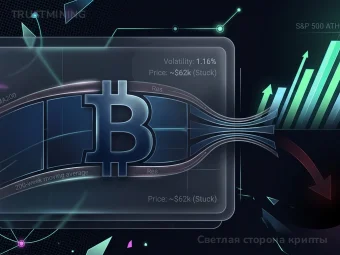

Светлая сторона крипты
Ветры зимы в криптосфере
Почему биткоин застрял на месте, пока фондовый рынок бьет рекорды




Proof-of-Work (PoW) is a consensus mechanism in which participants in a blockchain network perform computational work to obtain the right to propose a new block. Unlike mechanisms based on asset ownership or voting, PoW uses measurable computational cost as one of the main elements of network security.
How Proof-of-Work Works
When creating a block, a value must be found such that the result of cryptographic hashing meets a condition established by the protocol. Since it is practically impossible to predict a suitable value in advance, a participant must perform a large number of attempts.
Each individual attempt is relatively simple, but finding a suitable result requires a significant amount of computation. Once a solution is found, other participants can quickly verify its correctness.
The Role of Network Difficulty
The network adjusts the required difficulty of the computational task so that new blocks are produced at the frequency specified by the protocol. If the total computational power of the network increases, difficulty may also increase in networks with an automatic difficulty adjustment mechanism.
Therefore, changes in the computational power of individual miners and the network as a whole affect the probability of a particular participant finding a block.
Network Security
One of the key properties of Proof-of-Work is that creating an alternative blockchain history requires significant computational resources. The more computational work accumulated in the chain, the more expensive an attempt to rewrite its history becomes.
The economic model additionally incentivizes honest participation: a miner consumes electricity and uses hardware with the expectation of receiving a block reward. An attack on the network requires not only computational resources but also the corresponding costs of operating them.
Proof-of-Work and Mining
Mining in PoW networks represents the practical implementation of the computational work required by this consensus mechanism. Miners compete for the opportunity to add the next block by performing computations using specialized or general-purpose hardware.
Popular models

Brands


Fluminer

ElphaPex

Ebang

Canaan

Todek

Bitdeer

iPollo

Baikal

StrongU

VolcMiner

MicroBT

Lucky Miner

Jasminer

Auradine

Innosilicon

IceRiver

Hummer Miner

Holic

Heatbit

Goldshell

FusionSilicon

Bitaxe

Bitfily

Digital Shovel

Dayun

Bolon Miner

Braiins

BW

Halong Mining

Bitfury

Spondoolies

PinIdea

Pantech

Obelisk

DragonBall Miner

FFMiner

ForestMiner

GMO miner