Advertisements
Top weekly article
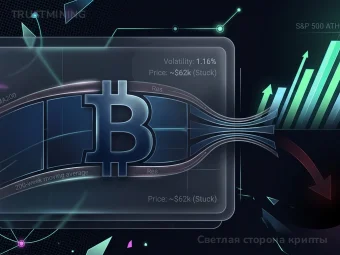

Светлая сторона крипты
Ветры зимы в криптосфере
Почему биткоин застрял на месте, пока фондовый рынок бьет рекорды




Stratum V1 is a communication protocol between miners and mining-pool servers that became widely adopted in cryptocurrency mining infrastructure. Its primary purpose is to provide continuous communication for distributing jobs and receiving computational results from connected devices.
How Stratum V1 Works
- The miner establishes a connection to the pool server.
- The device or client provides information identifying the worker.
- The pool sends the job parameters.
- The miner performs computations.
- When a suitable result is found, the miner submits a share.
- The pool verifies the result and returns acceptance or rejection information.
- When the job changes, the miner receives new parameters.
Why Stratum V1 Became Widely Used
The protocol made it practical to coordinate large numbers of miners through centralized pool servers. Instead of requiring every device to continuously process and exchange large amounts of blockchain information, the pool could distribute compact jobs and receive computational results.
This is particularly useful for specialized mining hardware that performs computations at very high speed and can be sensitive to communication delays.
Limitations
Stratum V1 was developed around an architecture in which a significant portion of mining coordination is controlled by the pool. Newer approaches place more emphasis on communication security, authentication, flexible role distribution, and reducing the dependence of individual components on centralized control.
These are among the considerations that led to the development of Stratum V2.
Specific behavior can differ depending on the implementation, mining client, and blockchain network.
Popular models

Brands


Fluminer

ElphaPex

Ebang

Canaan

Todek

Bitdeer

iPollo

Baikal

StrongU

VolcMiner

MicroBT

Lucky Miner

Jasminer

Auradine

Innosilicon

IceRiver

Hummer Miner

Holic

Heatbit

Goldshell

FusionSilicon

Bitaxe

Bitfily

Digital Shovel

Dayun

Bolon Miner

Braiins

BW

Halong Mining

Bitfury

Spondoolies

PinIdea

Pantech

Obelisk

DragonBall Miner

FFMiner

ForestMiner

GMO miner