Advertisements
Top weekly article
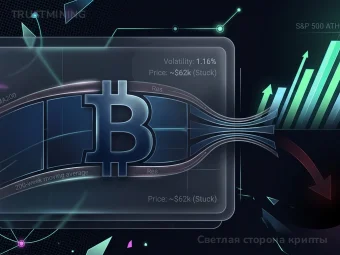

Светлая сторона крипты
Ветры зимы в криптосфере
Почему биткоин застрял на месте, пока фондовый рынок бьет рекорды




Immersion cooling is a heat-removal technology in which mining equipment or selected components are submerged in a specially designed electrically non-conductive fluid. The fluid directly contacts heated surfaces and transfers their thermal energy toward a heat exchanger or another part of the cooling system.
The main difference between immersion cooling and air cooling is the medium that directly receives heat from the equipment. Instead of moving large volumes of air, the system uses a specialized dielectric fluid that can contact electrical components without creating a conventional conductive path.
How Immersion Cooling Works
- ASIC equipment is installed inside a dedicated tank.
- The equipment is submerged in compatible dielectric fluid.
- Heat from computing components is transferred to the fluid.
- Heated fluid moves through the cooling system.
- A heat exchanger transfers the thermal energy to another circuit or the environment.
- Cooled fluid returns to the equipment.
Single-Phase and Two-Phase Systems
In single-phase immersion systems, the working fluid remains liquid throughout the cooling cycle. It absorbs heat from the equipment, moves to the heat exchanger, releases that heat, and returns to the tank.
In two-phase systems, the working fluid evaporates when heated. The vapor rises to a condensing area, releases heat, and returns to liquid form. This approach uses a phase change as part of the heat-transfer process.
Advantages
- high heat-transfer capability;
- high equipment density can be supported;
- reduced dependence on large air volumes;
- reduced reliance on conventional high-speed fans;
- more uniform heat transfer across immersed components.
Infrastructure Requirements
An immersion system requires dedicated tanks, compatible fluid, heat exchangers, and an organized cooling loop. Material compatibility must also be considered for circuit boards, cables, seals, plastics, adhesives, and metals.
Immersion cooling is particularly relevant where the equipment produces a high thermal load. It does not eliminate the need to reject heat from the facility; instead, it changes how heat is transferred from the mining equipment to the external heat-rejection system.
Popular models

Brands


Fluminer

ElphaPex

Ebang

Canaan

Todek

Bitdeer

iPollo

Baikal

StrongU

VolcMiner

MicroBT

Lucky Miner

Jasminer

Auradine

Innosilicon

IceRiver

Hummer Miner

Holic

Heatbit

Goldshell

FusionSilicon

Bitaxe

Bitfily

Digital Shovel

Dayun

Bolon Miner

Braiins

BW

Halong Mining

Bitfury

Spondoolies

PinIdea

Pantech

Obelisk

DragonBall Miner

FFMiner

ForestMiner

GMO miner