Advertisements
Top weekly article
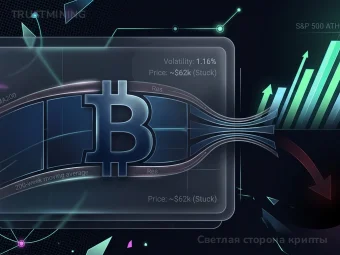

Светлая сторона крипты
Ветры зимы в криптосфере
Почему биткоин застрял на месте, пока фондовый рынок бьет рекорды




Cooling loop is an organized circulation path that moves coolant between mining equipment and the heat rejection system. In mining installations, the loop may be closed or may consist of multiple connected circuits.
The main purpose of the loop is to continuously transport heat from the equipment to a heat exchanger. After releasing the heat, cooled coolant returns to the miners and repeats the process.
Typical Cooling Cycle
- Coolant enters the cooling hardware.
- It absorbs heat from the equipment.
- A pump moves the heated coolant through the system.
- The coolant reaches a heat exchanger.
- Thermal energy is transferred to another circuit or the environment.
- Cooled coolant returns to the equipment.
Main Components
- piping;
- pumps;
- cooling blocks;
- heat exchangers;
- expansion tanks;
- filters;
- temperature, pressure, and flow sensors.
Loop performance depends on coolant flow rate, hydraulic resistance, pump characteristics, and heat exchanger performance. These parameters must match the actual equipment thermal load.
Temperature Difference
Delta T between the inlet and outlet is an important operating parameter. It shows how much the coolant temperature changes while passing through the equipment.
For large mining facilities, cooling loop reliability is critical. Pump failure, leakage, or insufficient flow can cause temperatures to increase across a large number of machines simultaneously.
Popular models

Brands


Fluminer

ElphaPex

Ebang

Canaan

Todek

Bitdeer

iPollo

Baikal

StrongU

VolcMiner

MicroBT

Lucky Miner

Jasminer

Auradine

Innosilicon

IceRiver

Hummer Miner

Holic

Heatbit

Goldshell

FusionSilicon

Bitaxe

Bitfily

Digital Shovel

Dayun

Bolon Miner

Braiins

BW

Halong Mining

Bitfury

Spondoolies

PinIdea

Pantech

Obelisk

DragonBall Miner

FFMiner

ForestMiner

GMO miner