Advertisements
Top weekly article
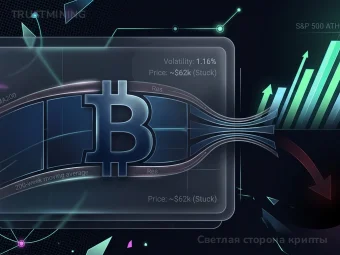

Светлая сторона крипты
Ветры зимы в криптосфере
Почему биткоин застрял на месте, пока фондовый рынок бьет рекорды




Solo mining is a method of mining cryptocurrency in which a miner independently participates in finding new blocks without combining computational resources with other participants through a pool.
When a block is successfully found, the participant receives the block reward specified by the protocol. It is not distributed among other miners because the computational work was not combined within a shared pool.
How Solo Mining Works
The miner independently connects to the blockchain network or uses appropriate software, receives the data required to construct a block, and performs the necessary computations. If the discovered solution satisfies the network rules and the block is accepted by other participants, the miner receives the specified reward.
The key feature of solo mining is the probabilistic nature of its income. Having greater computational power increases the probability of finding a block but does not guarantee regular payouts.
Solo Mining vs. Pool Mining
| Characteristic | Solo Mining | Pool Mining |
|---|---|---|
| Computational power | Used independently | Combined with other participants |
| Payouts | Irregular, when a block is found | Typically more frequent and smaller |
| Reward distribution | The participant receives the reward independently | The reward is distributed among participants |
| Dependence on a pool | None | Yes |
When Solo Mining Makes Sense
Solo mining becomes more predictable when a participant has a large share of the network's total computational power. With a small amount of computational power, the probability of finding a block may be so low that periods without income become very long.
Therefore, when evaluating solo mining, it is important to consider not only the expected average profitability but also the probability of experiencing a prolonged period without finding a block.
Popular models

Brands


Fluminer

ElphaPex

Ebang

Canaan

Todek

Bitdeer

iPollo

Baikal

StrongU

VolcMiner

MicroBT

Lucky Miner

Jasminer

Auradine

Innosilicon

IceRiver

Hummer Miner

Holic

Heatbit

Goldshell

FusionSilicon

Bitaxe

Bitfily

Digital Shovel

Dayun

Bolon Miner

Braiins

BW

Halong Mining

Bitfury

Spondoolies

PinIdea

Pantech

Obelisk

DragonBall Miner

FFMiner

ForestMiner

GMO miner