Advertisements
Top weekly article
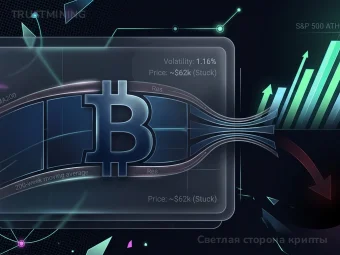

Светлая сторона крипты
Ветры зимы в криптосфере
Почему биткоин застрял на месте, пока фондовый рынок бьет рекорды




Merge Mining is a technology that allows the same computational work to be used simultaneously for mining multiple compatible blockchains. As a result, a miner can receive rewards from multiple networks without performing a completely separate amount of computation for each one.
How Merge Mining Works
One network typically acts as the primary chain, while an auxiliary network uses proof of completed work to verify that a computational task has already been solved. If the solution meets the requirements of the auxiliary blockchain, it may also be accepted by that network.
Thus, the auxiliary blockchain can use computational work that has already been performed as part of the primary network. This allows a smaller network to increase its security without having to independently attract a comparable amount of computational resources.
Economic Meaning
For miners, the main advantage of Merge Mining is the ability to receive additional rewards without a proportional increase in computational workload. Additional profitability depends on the specific rules of the networks and the value of the assets received.
However, Merge Mining requires technical compatibility between the blockchains. Not every PoW network can use this technology, and the mechanism for verifying the proof of work must be provided for by the protocol.
Relationship with Proof-of-Work
Merge Mining is particularly associated with blockchains that use a compatible Proof-of-Work mechanism. Its purpose is not to change the mining principle itself, but to reuse computational work that has already been performed in another compatible network.
Popular models

Brands


Fluminer

ElphaPex

Ebang

Canaan

Todek

Bitdeer

iPollo

Baikal

StrongU

VolcMiner

MicroBT

Lucky Miner

Jasminer

Auradine

Innosilicon

IceRiver

Hummer Miner

Holic

Heatbit

Goldshell

FusionSilicon

Bitaxe

Bitfily

Digital Shovel

Dayun

Bolon Miner

Braiins

BW

Halong Mining

Bitfury

Spondoolies

PinIdea

Pantech

Obelisk

DragonBall Miner

FFMiner

ForestMiner

GMO miner