Advertisements
Top weekly article
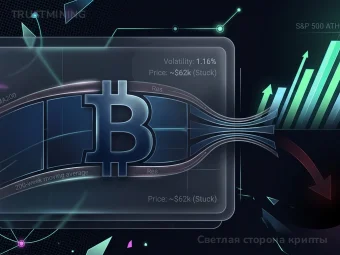

Светлая сторона крипты
Ветры зимы в криптосфере
Почему биткоин застрял на месте, пока фондовый рынок бьет рекорды




Dual Mining is a mode in which a single computing device simultaneously participates in mining two cryptocurrencies or performing two mining tasks. This capability depends on the hardware architecture, software being used, and algorithm compatibility.
How Dual Mining Works
In conventional mining, a device directs its available computational resources toward a single task. In Dual Mining, resources are divided between two tasks. The specific mechanism depends on the hardware and mining software being used.
In some implementations, the primary task uses most of the available resources while the second task uses the remaining capacity. In other configurations, the device architecture allows two types of computations to be performed more concurrently.
Advantages
- the ability to earn income from two assets simultaneously;
- more complete utilization of the hardware's computational resources;
- the ability to diversify the assets being mined;
- potentially higher overall device profitability.
Limitations
Dual Mining does not automatically mean higher net profit. The additional task may increase power consumption, temperature, and hardware load. In some configurations, the performance of the primary task may also decrease.
Therefore, this mode should be evaluated based on total net profit after accounting for electricity costs, reduced performance, fees, and other operating expenses.
Dual Mining vs. Merge Mining
Dual Mining should not be confused with Merge Mining. In Merge Mining, the same computational work can be used for multiple compatible blockchains, whereas Dual Mining generally involves simultaneously performing two separate mining tasks.
Popular models

Brands


Fluminer

ElphaPex

Ebang

Canaan

Todek

Bitdeer

iPollo

Baikal

StrongU

VolcMiner

MicroBT

Lucky Miner

Jasminer

Auradine

Innosilicon

IceRiver

Hummer Miner

Holic

Heatbit

Goldshell

FusionSilicon

Bitaxe

Bitfily

Digital Shovel

Dayun

Bolon Miner

Braiins

BW

Halong Mining

Bitfury

Spondoolies

PinIdea

Pantech

Obelisk

DragonBall Miner

FFMiner

ForestMiner

GMO miner