Advertisements
Top weekly article
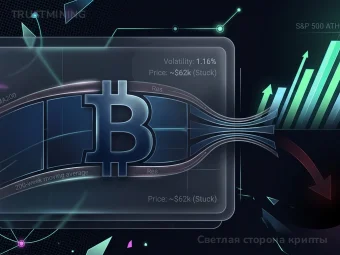

Светлая сторона крипты
Ветры зимы в криптосфере
Почему биткоин застрял на месте, пока фондовый рынок бьет рекорды



PPLNS (Pay Per Last N Shares) is a mining-pool payout scheme in which the last N shares are considered when distributing a block reward. The exact definition of the window and the rules used to apply it depend on the pool implementation.
Unlike a scheme where every accepted share receives a predetermined calculated value independently of when a block is found, PPLNS links the payout to a specific historical set of participant work.
How PPLNS Works
- The pool continuously receives and records accepted shares.
- Participants contribute work at different hashrates.
- The pool finds a block.
- The applicable window of the last N shares is determined.
- Each participant’s share of the total contribution within that window is calculated.
- The distributable reward is divided according to the credited contribution.
Why the Window Size Matters
With a smaller window, the result is more sensitive to recent activity and the timing of a miner’s participation. With a larger window, short-term changes in participation are distributed over a broader set of work.
Therefore, two pools that both use PPLNS can produce different payout patterns if they use different values of N or different rules for defining the calculation window.
Example
Assume a pool uses a window of 1,000,000 shares. If a particular participant’s equipment contributes shares representing 2% of the total credited work within that window, the participant’s share of the distributable reward would be calculated from that 2%, subject to the pool’s rules and fee.
If a miner starts working immediately before a block is found, a significant portion of their work may not be included in the relevant historical window.
PPLNS and Payout Regularity
PPLNS does not guarantee equal payouts at equal time intervals. Actual income depends on the blocks found by the pool, participant contribution, and the size of the calculation window. As a result, payouts can fluctuate even when hashrate remains relatively stable.
Popular models

Brands


Fluminer

ElphaPex

Ebang

Canaan

Todek

Bitdeer

iPollo

Baikal

StrongU

VolcMiner

MicroBT

Lucky Miner

Jasminer

Auradine

Innosilicon

IceRiver

Hummer Miner

Holic

Heatbit

Goldshell

FusionSilicon

Bitaxe

Bitfily

Digital Shovel

Dayun

Bolon Miner

Braiins

BW

Halong Mining

Bitfury

Spondoolies

PinIdea

Pantech

Obelisk

DragonBall Miner

FFMiner

ForestMiner

GMO miner