Advertisements
Top weekly article
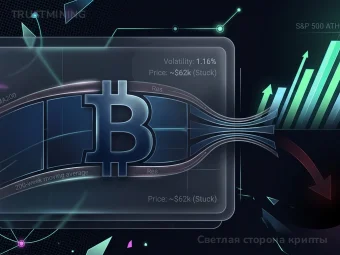

Светлая сторона крипты
Ветры зимы в криптосфере
Почему биткоин застрял на месте, пока фондовый рынок бьет рекорды




Pool Mining is a mining model in which multiple independent participants combine their computing resources through a shared Mining Pool. Each participant continues performing computations on their own hardware, while the resulting work is submitted to shared pool infrastructure.
The main reason for using Pool Mining is the probabilistic nature of block discovery. If an individual miner controls only a small share of the network’s computing power, the probability that their equipment finds the next block can be low. Combining many miners increases the frequency with which the group as a whole can find blocks.
Pool Mining Mechanics
The pool creates jobs and distributes them to connected devices. Participant contribution is tracked using shares — computational results that meet the difficulty configured by the pool. The miner submits these results to the server, and the pool verifies them and associates them with a specific worker.
When the pool finds a block, the resulting reward is distributed among participants. The distribution method is defined by the payout scheme. Some schemes primarily use the number and difficulty of accepted shares, while others use a defined historical or quantitative window.
Pool Mining vs. Solo Mining
| Characteristic | Pool Mining | Solo Mining |
|---|---|---|
| Combined computing power | Yes | No |
| Job source | Pool | Network or own infrastructure |
| Share tracking | Yes | Normally not required in the pool sense |
| Reward distribution | Among participants according to pool rules | Goes to the participant that finds the block |
| Pool fee | May apply | None |
Economic Characteristics
Pool Mining does not increase the computing power of an individual device. It changes how that power is organized and how the resulting rewards are distributed. Participant economics therefore depend not only on hashrate but also on pool fees, payout schemes, network difficulty, block rewards, and electricity costs.
For a participant with a small hashrate, payout regularity can also matter. Even when expected income is determined by the same network parameters, the actual timing of payments depends on the selected payout model and the frequency with which the pool finds blocks.
Related Concepts
Pool Mining is directly related to Mining Pool, Share, Pool Fee, Payout Scheme, and the Stratum protocol.
Popular models

Brands


Fluminer

ElphaPex

Ebang

Canaan

Todek

Bitdeer

iPollo

Baikal

StrongU

VolcMiner

MicroBT

Lucky Miner

Jasminer

Auradine

Innosilicon

IceRiver

Hummer Miner

Holic

Heatbit

Goldshell

FusionSilicon

Bitaxe

Bitfily

Digital Shovel

Dayun

Bolon Miner

Braiins

BW

Halong Mining

Bitfury

Spondoolies

PinIdea

Pantech

Obelisk

DragonBall Miner

FFMiner

ForestMiner

GMO miner