Advertisements
Top weekly article
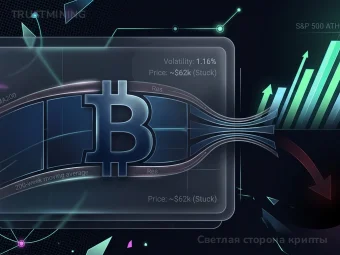

Светлая сторона крипты
Ветры зимы в криптосфере
Почему биткоин застрял на месте, пока фондовый рынок бьет рекорды




Mining Pool is server infrastructure and an accounting system that combines the computing power of multiple participants for collaborative mining. Instead of each miner independently waiting to find a block and potentially receiving no income for a long period, participants connect to a shared pool and regularly submit the results of their computational work.
The pool does not physically combine the mining devices. Each miner continues performing computations on its own hardware, while the pool infrastructure distributes jobs, receives results, and records each participant’s contribution. As a result, the combined computing power of the pool has a much greater chance of finding a block than a small individual miner operating alone.
How a Mining Pool Works
- The miner configures its equipment and connects it to a pool server.
- The pool identifies the connected device or worker and assigns it a job.
- The miner performs computations and searches for results that meet the pool’s configured share difficulty.
- Suitable results are sent back to the pool as shares.
- The pool verifies the submitted results and records valid shares in the participant’s statistics.
- If one participant finds a valid block, the pool processes the block according to the rules of the blockchain network.
- The resulting reward is distributed among participants according to the selected payout scheme.
Why Shares Are Used
Full blocks are found relatively infrequently compared with the number of computational attempts performed by miners. The pool therefore needs an intermediate metric that allows it to measure each participant’s work regularly. This metric is the share.
The pool assigns a separate share difficulty that is normally much lower than the network difficulty. This allows even relatively small miners to submit results regularly. The frequency and difficulty of accepted shares provide the pool with a statistical estimate of the work actually performed by each participant.
A share is normally not a complete block. However, a sufficiently difficult share can also satisfy the blockchain’s network-level requirement. In that case, the result can represent a valid block candidate.
What the Pool Tracks
| Metric | Practical Meaning |
|---|---|
| Hashrate | Shows the computing power of connected equipment. |
| Shares | Used to confirm and measure completed work. |
| Rejected shares | Shows results that were not credited by the pool. |
| Worker status | Allows individual devices to be monitored for connection and activity. |
| Payout balance | Shows the participant’s accumulated reward. |
How Rewards Are Distributed
When a block is found, the pool receives the reward defined by the network protocol. It can include the block reward, consisting of the subsidy and transaction fees.
The participant normally does not receive the entire block reward individually. A pool fee may first be deducted, after which the remaining amount is distributed among participants according to the selected payout scheme.
For example, under PPS, a payout can be calculated for each accepted share, while PPLNS uses a defined set of recent shares. Therefore, the same hashrate can produce different payment patterns depending on the payout model.
Main Mining Pool Parameters
- Pool fee — the fee retained by the pool.
- Payout threshold — the minimum balance required for a payout.
- Payout scheme — the rules used to calculate rewards.
- Share difficulty — the difficulty used for intermediate results.
- Stratum — the communication protocol used for jobs and results.
- VarDiff — a mechanism for automatically changing share difficulty.
What Matters When Evaluating a Pool
The fee is only one parameter. Server stability, connection latency, the rate of rejected and stale shares, payout rules, minimum payout threshold, and supported protocols can also affect the practical result of mining.
If communication between the miner and pool is unstable, some computational work can become stale before it reaches the server. Therefore, pool infrastructure and network quality can affect the effective performance of mining equipment.
A mining pool is the infrastructure layer connecting individual miners with collaborative block production. Understanding it requires distinguishing Pool Mining, Share, Payout Scheme, and the Stratum protocol.
Popular models

Brands


Fluminer

ElphaPex

Ebang

Canaan

Todek

Bitdeer

iPollo

Baikal

StrongU

VolcMiner

MicroBT

Lucky Miner

Jasminer

Auradine

Innosilicon

IceRiver

Hummer Miner

Holic

Heatbit

Goldshell

FusionSilicon

Bitaxe

Bitfily

Digital Shovel

Dayun

Bolon Miner

Braiins

BW

Halong Mining

Bitfury

Spondoolies

PinIdea

Pantech

Obelisk

DragonBall Miner

FFMiner

ForestMiner

GMO miner